
If you own a home in Port St. Joe, Mexico Beach, Cape San Blas or anywhere along the Forgotten Coast, a few pages of checkboxes may have more effect on the wind portion of your homeowners premium than almost anything else you hand your insurance company. That paperwork is the wind mitigation form, officially Florida’s Uniform Mitigation Verification Inspection Form, OIR-B1-1802. Most homeowners never read it. They schedule an inspection, get a PDF and pass it along. But each question on the form asks about one specific feature of your house, and the box the inspector checks may decide whether a credit applies, depending on your carrier and subject to underwriting.
Insuring the Coast Insurance Agency is an independent agency at 402 Reid Ave, Ste B, in Port St. Joe, and we serve the Panhandle of Florida. We’ve already covered why a wind mitigation inspection matters and how storm shutters count for opening protection. This guide goes one step further: a plain-English walkthrough of the questions on the form itself, what each answer means, and what your inspector needs to see.
In this guide
First, a Quick Update: The Form Now Has 9 Questions
For years, people talked about the “7 wind mitigation questions.” The current OIR-B1-1802 (Rev. 04/26) form from the Florida Office of Insurance Regulation keeps those seven features and adds two new ones, Region and Roof Slope. The Florida Department of Financial Services says the new version is required for inspections on or after April 1, 2026.
Florida law (section 627.0629, Florida Statutes) requires insurers to include discounts, credits or other rate differentials for features that reduce wind loss. How much any one answer is worth is set by each insurer’s filed rates, so the same form may be treated differently by different carriers. The form itself notes that some items may not qualify for a discount.
The 7 Core Questions
1. Building Code
This asks which Florida Building Code was in force when the home’s original permit was applied for: FBC 2001/2004, FBC 2007 or later, or (in Miami-Dade and Broward only) the South Florida Building Code. For homes built in 2002-2003 or 2007-2008, the inspector needs a permit application date to prove which code applied. Newer-code homes may qualify for a building-code credit with some carriers. If the year can’t be confirmed, the answer is “Unknown.”
2. Roof Covering
The inspector lists every roof covering (shingle, tile, metal, membrane and so on) and needs a roofing permit application date or a Florida or Miami-Dade product approval number, plus the year it was installed. In general, a roof permitted on or after March 1, 2002, or an original roof on a home built in 2004 or later, meets the top answer. Keep your re-roof permit. It’s often the single most useful document for this question.
3. Roof Deck Attachment
This looks at how the plywood or OSB sheathing is nailed to the trusses, from the attic. The form rates the weakest attachment, from staples or 6d nails (A) up to 8d nails at 6 inches in the field (C), plus reinforced concrete decks and qualifying spray foam. If there’s no attic access, or the nailing can’t be seen, the answer may be “Unknown” or “No attic access.”
4. Roof-to-Wall Attachment
This is how the roof framing is tied to the walls: toenails, clips, single wraps or double wraps, or a structural connection such as a reinforced concrete roof. Again it’s the weakest connection that counts, and the form now spells out nail counts and minimum uplift capacities for each level. Clear attic photos of the straps help your inspector document this.
5. Roof Geometry
Hip roofs, with sloped sides on all four sides and non-hip features under 10% of the total roof perimeter, are their own category. Flat roofs apply to buildings with five or more units. Everything else, including most gable roofs, is “Other.” Roof shape may be one of the more significant factors, depending on the carrier.
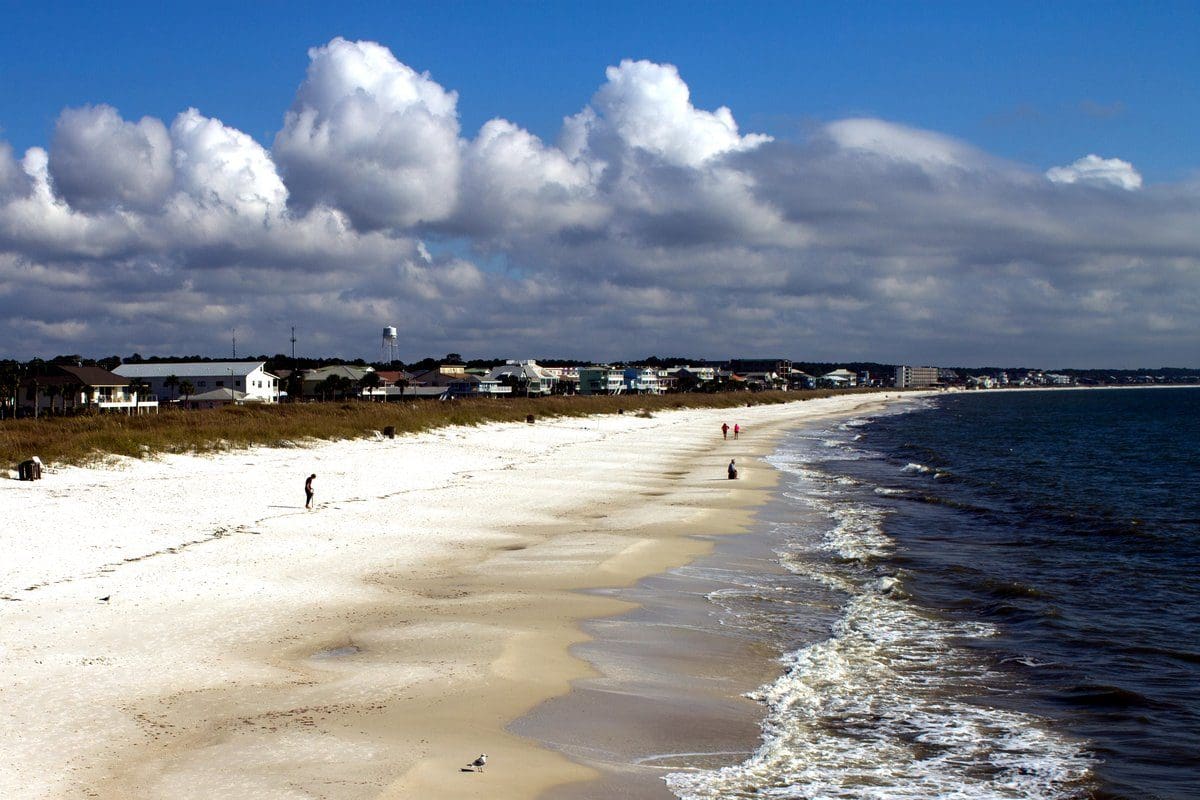
From Mexico Beach to Port St. Joe, each answer on your wind mitigation form may affect the wind portion of your premium.
6. Secondary Water Resistance (Sealed Roof Deck)
SWR is a backup layer meant to help keep water out if shingles blow off. It qualifies if it’s a fully adhered self-adhering membrane, taped deck seams, or a double layer of qualifying felt or synthetic underlayment. Standard underlayment or hot-mopped felt doesn’t qualify. This is usually documented by the roofer’s permit or invoice, since it can’t be seen once the roof is on.
7. Opening Protection
This asks for the weakest windborne-debris protection on every window, door, skylight and garage door. One unprotected opening can lower the whole rating, and damaged openings can disqualify the home from mitigation credits. We broke this one down in detail in our shutters and opening protection guide.
Already have a wind mitigation report? We can review whether available credits are reflected on your policy.
The 2 New Questions: Region and Roof Slope
Region
Your home is placed by design wind speed using the ASCE Hazard Tool: High-Velocity Hurricane Zone, Region 1 (140 mph or more), Region 2 (130-139 mph) or Region 3 (under 130 mph). It’s based on location, not on anything you can change.
Roof Slope
The inspector notes whether the main roof (at least two-thirds of it) is steeper or flatter than 6:12. It’s a fact about the house rather than an upgrade, but it’s part of how the home is described.
What Your Inspector Needs to See
The form requires at least one photo or document for each attribute marked in questions 2 through 9. A FORTIFIED Home certificate from IBHS can be used to validate several items, and your insurer may ask follow-up questions. A completed form is valid for up to five years if nothing material changes, though acceptance is up to the carrier.
Need an inspector? Insuring the Coast Insurance Agency recommends Trevor Seay of Seay Level Home Inspections for wind mitigation inspections in Port St. Joe and along the Forgotten Coast. Seay Level is an independent business, not part of Insuring the Coast or any state program. You can use any qualified inspector. Eligible homeowners may also be able to get an inspection through the state’s My Safe Florida Home program, subject to its eligibility rules and available funding.
Quick Checklist Before Your Inspection
-
✓Find your original building permit date or year built
-
✓Find your re-roof permit, roofer’s invoice and product approval number
-
✓Ask your roofer whether secondary water resistance was installed
-
✓Clear a path to the attic access
-
✓Gather shutter, window and garage door labels or approval numbers
-
✓Repair any cracked or damaged windows and doors first
-
✓Send the finished report to your agent
How Insuring the Coast Can Help
Once you have your report, send it to us. We’ll review whether available credits are reflected on your policy and, if it makes sense, compare options from the carriers we can quote, subject to underwriting and availability. Call or text (850) 203-3643, email , or request a homeowners insurance quote online. You can also learn more about our Florida homeowners insurance options.
Have your wind mitigation report ready? Let us take a look.
Prefer to stop by? Visit our Port St. Joe insurance office at 402 Reid Ave, Ste B, Port St. Joe, FL 32456.
Frequently Asked Questions
How many questions are on the Florida wind mitigation form?
The current OIR-B1-1802 (Rev. 04/26) has nine numbered questions. The seven long-standing features are building code, roof covering, roof deck attachment, roof-to-wall attachment, roof geometry, secondary water resistance and opening protection. Region and roof slope were added in the 2026 revision.
Will a wind mitigation inspection lower my premium?
Not always. It depends on your home’s features, your carrier’s filed rates and underwriting. Some homes see little or no change, and the form itself notes some items may not qualify for a discount.
Is my old wind mitigation report still good?
A completed form is generally valid for up to five years if there have been no material changes or inaccuracies. Acceptance is up to your carrier, so ask before you assume it still applies.
What if my inspector can’t get into the attic?
The roof deck and roof-to-wall questions may be marked “No attic access” or “Unknown,” which may mean no credit for those items. Clearing the access before the inspection can help.
Does a new roof change my wind mitigation answers?
It can. A new roof may change the roof covering, roof deck attachment and secondary water resistance answers, so it’s worth getting a new inspection after a re-roof and sending it to your agent.
General info, not policy or legal advice.
This article is provided by Insuring the Coast Insurance Agency for general informational purposes only. It is not an insurance contract, a guarantee of coverage or rates, or legal advice. Coverage is subject to the terms, conditions and exclusions of the policy issued, as well as underwriting approval and availability. Premiums, credits and eligibility vary by carrier and property. Form descriptions are summarized from OIR-B1-1802 (Rev. 04/26); the official form controls. Please contact a licensed insurance agent to review your specific situation.


